Growth hormone isn't just about getting bigger — it's about recovery, body composition, sleep quality, and how well your body maintains itself as you age. Here's the full landscape of HGH optimization.
The Three Tiers of HGH Optimization
| Factor | Natural (Free) | OTC Secretagogue | Prescription Peptides |
|---|---|---|---|
| Approach | Sleep, training, fasting | Amino acids via oral spray (Sytropin) | Synthetic GHRH analogs via injection |
| Cost | Free | ~$60/mo | $200-500+/mo |
| Prescription | ✗ | ✗ | ✓ |
| Injection | ✗ | ✗ | ✓ |
| Measurable GH elevation | Moderate | Moderate | ✓ |
Tier 1: Natural (Do This First)
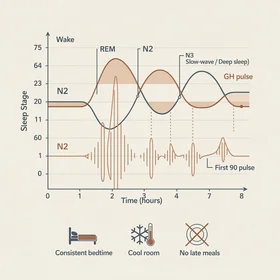
- Sleep 7-9 hours: 70% of daily GH released during deep sleep
- Train heavy compounds: Squats, deadlifts, rows trigger biggest GH spikes
- Intermittent fasting: 16-hour fasts significantly increase GH secretion
- Minimize late-night sugar: Insulin suppresses GH release
Tier 2: OTC Secretagogues

Sytropin — sublingual HGH secretagogue spray.
Sytropin delivers amino acid building blocks (L-Arginine, L-Glutamine, GABA, Alpha GPC) via sublingual spray to support natural pituitary GH production. 20+ years on market, no prescription needed. Best used on top of optimized lifestyle fundamentals.
Tier 3: Prescription Peptides
The clinical-grade approach. Key peptides:
- Sermorelin: GHRH analog — triggers natural pulsatile GH release. The most established GH peptide.
- Ipamorelin + CJC-1295: The most popular clinical stack — clean GH stimulation with sustained release. Synergistic effect.
- BPC-157: Recovery peptide — accelerates healing of tendons, ligaments, muscle, gut. Impressive animal data, limited human trials.
- TB-500: Tissue repair peptide — promotes cell migration, angiogenesis, inflammation reduction. Often stacked with BPC-157.
All prescription peptides require physician oversight, blood monitoring, and subcutaneous injection.
Alternatives to Sytropin and OTC Secretagogues
Sytropin is one approach to HGH support, but there are several other options worth evaluating. The right alternative depends on your goals, budget, and willingness to involve a physician.
Standalone Amino Acid Supplements
Instead of a pre-formulated secretagogue, you can purchase L-Arginine, L-Glutamine, GABA, and Alpha GPC individually. This is a lower-cost alternative that gives you precise control over dosing, though you lose the sublingual delivery advantage and the convenience of a single product. Other OTC options like GenF20 Plus and HyperGH 14x offer similar amino acid blends in capsule form.
Prescription Peptides as an Alternative
For men with confirmed low IGF-1 levels who want measurable GH elevation, prescription peptide therapy is the most potent alternative to OTC products. Sermorelin and the Ipamorelin + CJC-1295 stack deliver clinical-grade GH stimulation under physician monitoring. The trade-off: subcutaneous injections, regular blood work, and $200–500+/month in cost.
Lifestyle-Only Optimization
Another option is forgoing supplements entirely and focusing exclusively on the natural fundamentals — sleep quality (7–9 hours), heavy compound training, intermittent fasting, and stress management. This zero-cost alternative is where every man should start. For men under 35 with normal hormone levels, it may be all you need. The testosterone guide covers the hormonal fundamentals that complement natural GH optimization.
Injectable HGH (Somatropin)
Synthetic recombinant HGH is the most potent option but carries significant trade-offs: $800–2,000+/month, prescription required, side effects (joint pain, insulin resistance, potential organ growth), and it replaces rather than supports natural production. This is a medical intervention for diagnosed GH deficiency — not a casual fitness supplement.
Bottom line: Start with lifestyle optimization, layer in an OTC secretagogue for additional support, and reserve prescription peptides or injectable HGH for situations where blood work confirms clinical need. Visit our FAQ for answers to the most common questions about choosing between these approaches.
Before choosing a tier, read the HGH side effects guide. The risks are different for injections, peptides and oral sprays, and the difference should drive the decision.