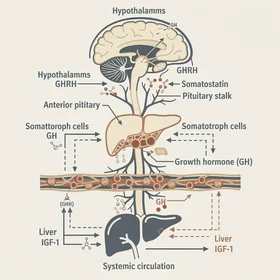
Growth hormone side effects depend almost entirely on how you raise the hormone. Prescription injections, peptides that stimulate release, and over-the-counter secretagogue sprays carry three different risk profiles, and most of what you read online lumps them together. This guide separates them, names the effects that actually show up in the medical literature, and tells you who should not use any of them.
Why the route matters more than the word "HGH"
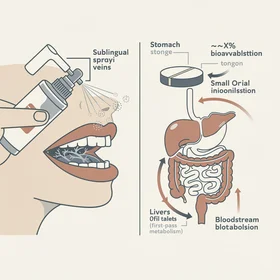
Every search for "growth hormone side effects" is really asking about one of three things. Somatropin, the prescription drug, is synthetic human growth hormone injected into the body. Growth hormone peptides such as sermorelin, ipamorelin and CJC-1295 are injected compounds that tell the pituitary to release more of its own hormone. Oral secretagogue supplements, the sprays and capsules sold without a prescription, use amino acids and related compounds to do the same thing at a much lower intensity.
The side effects scale with how much the hormone actually rises. Injected somatropin produces the largest and most reliable increase, and it has the longest list of documented effects. Peptides produce a smaller, pulsed rise that stays under your body's own feedback control. Oral sprays produce the smallest change of the three, and their side effects come from the individual amino acids rather than from growth hormone itself.
| Route | How much GH rises | Most common effects | Prescription |
|---|---|---|---|
| Somatropin injections | Large, sustained | Fluid retention, joint pain, carpal tunnel, raised blood sugar | Yes |
| GH peptides (sermorelin, ipamorelin, CJC-1295) | Moderate, pulsed | Injection-site redness, flushing, headache, water retention | Yes (compounded) |
| Oral secretagogue sprays | Small | Drowsiness or tingling (GABA), stomach upset or low blood pressure (L-Arginine) | No |
Side effects of growth hormone injections
The FDA prescribing information for somatropin products (Genotropin, Humatrope, Norditropin, Omnitrope and others) lists the same core group of adverse effects. They are worth knowing in plain terms.
- Fluid retention. Swelling in the hands, feet and ankles is the most common complaint in adults. It usually appears in the first weeks and often eases when the dose is lowered.
- Joint and muscle pain. Arthralgia and myalgia are reported by a meaningful share of adult patients, and they are the effects most likely to make people stop treatment.
- Carpal tunnel syndrome. Numbness, tingling and pain in the hands and wrists. It comes from the same fluid retention pressing on the median nerve, and it is dose related.
- Higher blood sugar. Growth hormone opposes insulin. Fasting glucose and insulin resistance can rise, and people with diabetes or prediabetes need closer monitoring. New cases of type 2 diabetes have been reported in long-term users.
- Headache. Common and usually mild. A severe or persistent headache, especially with vision changes or nausea, can signal raised pressure inside the skull and needs prompt medical attention.
- Gynecomastia. Breast tissue growth in men, reported in a small percentage of adult patients.
- Injection-site reactions. Redness, pain, and occasionally loss of fat under the skin at the injection site if the site is not rotated.
A 2007 systematic review in the Annals of Internal Medicine (Liu et al.) pooled 31 trials of growth hormone in healthy older adults and found the benefits were small, mostly a modest change in lean mass, while soft tissue swelling, joint pain, carpal tunnel syndrome and gynecomastia were all significantly more common in the treated groups. That review is the reason mainstream endocrinologists do not prescribe growth hormone as an anti-aging drug.
High growth hormone over the long term
Sustained excess growth hormone, whether from a pituitary tumor or from years of high-dose use, produces a condition called acromegaly. The visible signs are enlargement of the hands, feet and jaw, thickened skin, and a coarsening of facial features. The internal effects matter more: an enlarged heart, high blood pressure, sleep apnea, and a higher rate of colon polyps. These changes develop slowly and are largely irreversible, which is why the medical dosing of somatropin is kept to the lowest level that corrects a measured deficiency.
Who should not use growth hormone at all
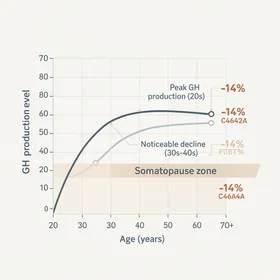
The somatropin label lists absolute contraindications, and they apply to any route that meaningfully raises the hormone.
- Active cancer. Growth hormone stimulates cell growth through IGF-1. Anyone with an active malignancy, or a recent history of one, should not use it.
- Acute critical illness. Trials in intensive-care patients recovering from surgery, trauma or respiratory failure found a higher death rate in the growth hormone group.
- Diabetic retinopathy. Growth hormone can worsen the eye disease that comes with diabetes.
- Prader-Willi syndrome with severe obesity or breathing problems. Sudden deaths have been reported in this group.
Beyond the absolute list, people with diabetes, thyroid disease, sleep apnea, or a family history of cancer need a doctor's judgment before starting anything in this category, including over-the-counter products.
Side effects in men and women
Most of the effects above apply to both sexes. Two differences show up in practice. Men are the ones who report gynecomastia, and men on higher doses are more likely to notice the coarsening of features that signals too much hormone. Women taking oral estrogen, including birth control pills and some hormone therapy, need higher growth hormone doses to get the same effect, because oral estrogen blunts IGF-1 production in the liver; the Endocrine Society's adult deficiency guideline (Molitch et al., Journal of Clinical Endocrinology & Metabolism, 2011) covers this in detail. Women also report fluid retention and joint pain at higher rates than men at the same dose, which is why dosing guidelines start women at a lower level.
Growth hormone for height in children
Pediatric growth hormone treatment has its own set of concerns, and they are different from the adult list. Slipped capital femoral epiphysis, a hip problem that shows up as limping or hip and knee pain, occurs more often in treated children. Scoliosis can progress faster during rapid growth. Raised pressure inside the skull, with headaches, vision changes and vomiting, is rare but serious and usually appears in the first months of treatment. Pediatric endocrinologists monitor for all three, and treatment for height is only prescribed after a diagnosed deficiency or a qualifying condition, never for a child who is simply shorter than average.
Side effects of growth hormone peptides
Sermorelin, ipamorelin, CJC-1295 and the GHRP compounds are prescribed off-label through compounding pharmacies. Because they stimulate the pituitary rather than replace the hormone, the rise in growth hormone is smaller and stays under the body's own negative feedback, and the injection-era effects above are much less common. What people actually report:
- Redness, swelling or itching at the injection site, the most common complaint.
- Flushing and a warm feeling in the face for a few minutes after the dose.
- Headache and light-headedness, usually early in a protocol.
- Water retention at higher doses.
- A sharp rise in appetite with GHRP-6 specifically, which acts on the same receptor as the hunger hormone ghrelin.
The honest limitation is that long-term safety data on peptides in healthy adults is thin. Most published work covers short trials or clinical populations. The same cancer and critical-illness cautions apply, since the end result is still more growth hormone and more IGF-1. Our peptides guide covers the individual compounds.
Side effects of oral HGH sprays and supplements
Over-the-counter secretagogues are a different category. They contain no growth hormone. The typical formula is a blend of amino acids (L-Arginine, L-Glutamine, GABA, glycine, ornithine), sometimes with L-Dopa bean extract, Alpha GPC or a homeopathic HGH component. The hormone response is small enough that the classic growth hormone side effects do not appear. What can appear are the effects of the individual ingredients:
- GABA can cause drowsiness, a tingling sensation in the skin, or mild shortness of breath at larger doses. Taken at night, the drowsiness is usually the point.
- L-Arginine can lower blood pressure and cause stomach upset. It should be used cautiously with blood-pressure medication, nitrates, or blood thinners.
- L-Dopa sources can interact with MAOI antidepressants and Parkinson's medication.
- Homeopathic HGH is diluted to the point of having no pharmacological dose, so it neither adds risk nor adds measurable hormone.
Sytropin, the oral spray we cover in the HGH guide, reports no known negative side effects and advises against use by children and by anyone taking MAOI medications. That matches the ingredient profile: the risks are the amino-acid interactions above, not growth hormone toxicity. If you take prescription medication for blood pressure, diabetes or a hormonal condition, run the ingredient list past your doctor first.
When to call a doctor
Stop and get medical advice if any of the following show up, on any route:
- A severe headache that does not respond to normal painkillers, especially with vision changes or vomiting.
- Swelling that spreads beyond the hands and feet, or sudden weight gain from fluid.
- Numbness or tingling in the hands that lasts more than a few days.
- Unusual thirst, frequent urination or blurred vision, which can signal high blood sugar.
- Breast tenderness or growth in men.
- Hip or knee pain and limping in a child on treatment.
The practical takeaway
If you have a diagnosed deficiency, prescription growth hormone under an endocrinologist is well studied and the side effects are manageable with dose adjustment and bloodwork. If you are a healthy adult looking for recovery, body composition or sleep, the evidence says the injection route's side effects outweigh its small benefits, and peptides are the compromise most optimization clinics reach for. Oral secretagogue sprays are the lowest-risk option because they change the least; judge them on their ingredient list, not on growth hormone pharmacology. Whatever route you choose, get baseline bloodwork, tell your doctor what you are taking, and treat any of the warning signs above as a reason to stop.